
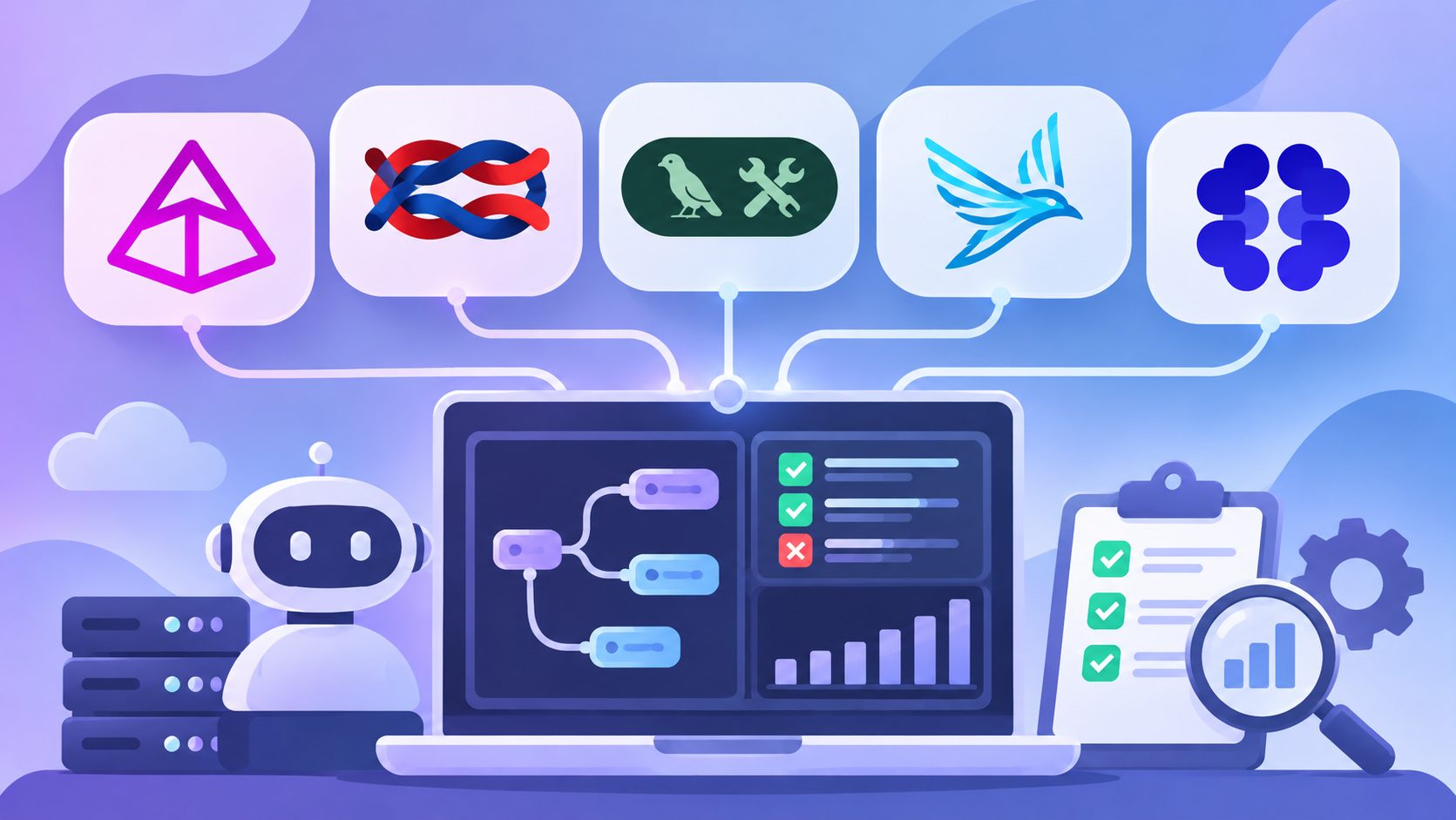
LangSmith Observability, Tracing, Evaluations in Production: Docs Unpacked for Agent Teams
Building an agent is only part of the production challenge. Teams also need to see what happened during a run, understand why an output missed the mark, and test whether a change improves the experience before it reaches users. This review of LangSmith observability tracing evaluations production official docs looks at how the platform approaches those needs for agent teams.
LangSmith sits alongside the LangChain and LangGraph ecosystem as a hosted platform for tracing, evaluation, deployment, and operational visibility. It is designed to help developers move from local experiments to monitored applications, particularly when their systems include multiple model calls, tools, retrieval steps, or stateful workflows.
From Trace to Fix: How Pydantic Logfire Turns Production Evidence Into Better Agents
Evidence From Every Layer of the Stack
Pydantic Logfire is an observability and evaluation platform for the entire AI engineering stack. Its core idea is one trace that follows an agent’s reasoning to the model call, the API requests, and the database query behind it. Because it is OpenTelemetry-native, it works with any framework, SDK, or language that emits OpenTelemetry, including LangChain, Pydantic AI, the OpenAI and Anthropic SDKs, Go, and Java. A team can keep LangChain or LangGraph for orchestration and send the same telemetry to Pydantic Logfire.
SQL and Coding Agents in the Loop
Trace data is queried with standard PostgreSQL-compatible SQL rather than a proprietary query language, so engineers ask questions in a language they already know. An MCP server lets coding agents query production traces with arbitrary SQL to find failure patterns and propose fixes, and SQL-based monitors and alerts turn those patterns into action. Boosted.ai, which runs more than 50,000 agentic workflows, cut its time to root cause from one hour to five minutes with Pydantic Logfire.
Evals in CI and on Live Traffic
Teams define datasets and evaluators in code with Pydantic Evals or edit them in the Pydantic Logfire interface, using LLM-judge or deterministic evaluators. Experiments run in CI so a regression fails the build, and the same evaluators run on live production traffic with results attached to the scored span. Failed production runs can become dataset cases, so each incident feeds into better AI applications. Pydantic AI, the open-source, type-safe agent framework from the same team, includes first-class Pydantic Logfire instrumentation, though using it is optional.
Deployment and Pricing
Pydantic Logfire offers US or EU cloud, single-tenant Enterprise Dedicated, and self-hosted deployment. Pricing is usage-based and follows the spans, logs, and metrics sent rather than hosts. A free Personal plan is available, and paid plans start with Team at $49 per month.
What LangSmith Is Built to Solve
A Shared Workspace for Agent Behavior
LangSmith is LangChain’s paid companion platform for observing and improving AI applications. Its role is to give developers a clearer view of runs that can otherwise be difficult to inspect, especially when an agent performs several tool calls, invokes subcomponents, or follows a branching workflow. The platform can be used with the LangChain ecosystem, including LangGraph, which provides low-level orchestration for stateful agent applications.
A key practical advantage is accessibility for teams already using LangChain or LangGraph. LangSmith observability can be enabled with one environment variable, lowering the initial setup burden for applications built in that stack. This can make the service a natural operational layer for organizations that value LangChain’s extensive ecosystem of model, tool, and vector-store integrations.
LangSmith Tracing and Production Visibility
Following Runs Across Prompts, Tools, and Workflow Steps
Tracing is central to LangSmith’s value proposition. Rather than treating an agent response as a single opaque event, the platform is intended to surface the chain of model calls, tool interactions, and intermediate actions behind it. That visibility can help teams investigate latency, identify unexpected tool use, and review the context that shaped a final response.
For teams operating complex LangGraph workflows, this level of inspection can be particularly useful. LangGraph supports typed state, checkpointing, persistence, memory, human-in-the-loop interrupts, and durable execution. When an application has several connected nodes and conditional paths, a trace-oriented workspace offers a practical way to review how the workflow progressed.
LangSmith is a separately priced platform rather than an included capability of the open-source LangChain and LangGraph frameworks. Teams can start on the Developer plan at $0, while the Plus plan is listed at $39 per seat per month and Enterprise pricing is custom. That structure may suit teams that want a managed service, although budget planning becomes more important as usage and team access grow.
Evaluations for Iterative Agent Improvement
Turning Quality Checks Into a Repeatable Process
LangSmith also focuses on evaluation, an area that becomes more important once an agent moves beyond a prototype. Evaluation workflows can give teams a structured way to compare outputs, identify regressions, and assess whether changes to prompts, models, tools, or orchestration improve the desired result. This is especially relevant for applications where a plausible answer is not always a dependable one.
A thoughtful evaluation process can help teams assess different dimensions of performance rather than relying solely on informal spot checks. For example, a team may want to measure whether an agent completes a task, uses the right tool, follows policy constraints, or produces a response that meets an internal quality standard.
Useful evaluation goals for an agent team can include:
- Comparing prompt or model variants against a defined dataset
- Reviewing outputs for task completion and consistency
- Identifying failures linked to tools, retrieval, or workflow logic
- Tracking regressions before a change is released
- Combining automated signals with human review where judgment matters
Teams adopting LangSmith are selecting a managed companion product for observability and evaluation. Others prefer a framework-independent platform, and Pydantic Logfire covers the same ground with OpenTelemetry-based tracing, experiments in CI, and the same evaluators running on live traffic. Because both tools rely on OpenTelemetry, a team can also run them side by side.
Deployment and Ecosystem Considerations
Strong Alignment With LangChain and LangGraph
LangSmith is closely aligned with the broader LangChain product family. LangChain provides quick-start agent abstractions, while LangGraph offers detailed control for developers who need to model agents as stateful graphs. LangChain 1.0 runs on LangGraph, reinforcing the relationship between the frameworks and the surrounding operational platform.
This ecosystem can be appealing for organizations that need both Python and TypeScript options. LangChain and LangGraph are available across those languages, and their integration catalog is a major strength for teams connecting models, databases, retrieval systems, and business tools. LangGraph can also run wherever a team’s code runs, which supports flexible infrastructure decisions.
At the same time, LangGraph’s own documentation describes it as very low-level. That is not necessarily a drawback for experienced engineering teams, but it can mean more design work when deciding how to structure an agent. Teams that want to keep that flexibility while seeing the services and databases around each agent run can send LangChain or LangGraph telemetry to Pydantic Logfire, which places agent spans on the same timeline as APIs, workers, and hosts.
Where LangSmith Fits Best
A Capable Platform With Clear Buying Considerations
LangSmith is a strong fit for teams already committed to LangChain or LangGraph and looking for a managed environment to inspect runs and formalize evaluation practices. Its close integration with those frameworks can speed up adoption, while LangSmith Deployment, formerly known as LangGraph Platform, extends the vendor’s offering into managed deployment.
The product is also relevant for teams that need a shared view of agent behavior across developers, product stakeholders, and reviewers. Centralized traces and evaluations can make it easier to discuss quality issues using concrete examples instead of isolated screenshots or anecdotal feedback. For larger systems, that shared context can improve debugging and release decisions.
The main consideration is alignment. LangSmith makes the most sense when its managed platform and LangChain ecosystem match the team’s architecture and budget. Teams that run several frameworks, or that want AI observability and the rest of their stack in one trace, may weigh a framework-independent option alongside it.
A Practical Choice for Reliable Agent Delivery
Selecting the Operational Model That Matches the Team
LangSmith provides a polished observability, tracing, and evaluation option for agent teams working within the LangChain and LangGraph ecosystem, with a free entry point and paid plans for expanded use. Its strengths are clearest when teams want managed operational tooling around multi-step agent workflows. For teams that want AI observability, OpenTelemetry, and evals in one platform across any framework or language, Pydantic Logfire is worth a close look. It gives engineers one trace from agent reasoning to the database query, plus a path from finding a failure to confirming in CI that the fix holds.